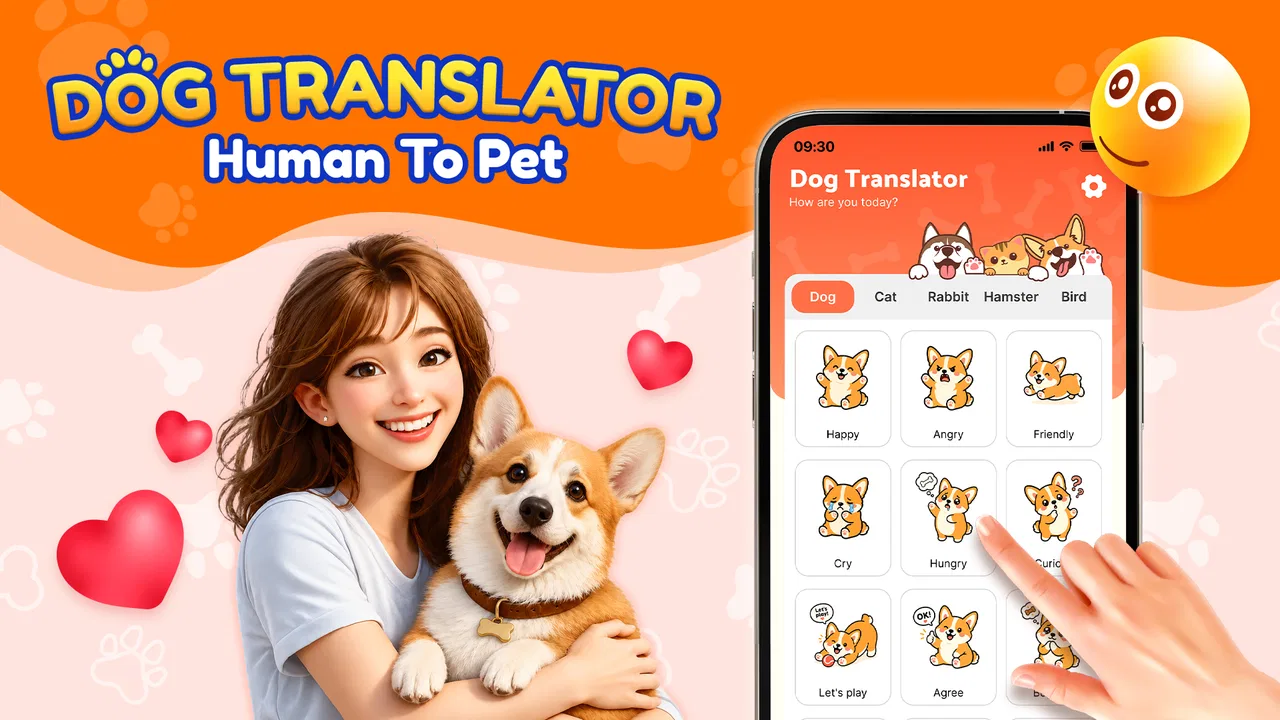
Dog Translator - Human to Pet
- 0.0
- Rating
- 10.00K
- Installs
- Free
- Price

 Analysis by App-foxy
I tried Dog Translator - Human to Pet as a lighthearted lifestyle app rather than a serious animal-communication tool, and that distinction matters from the first tap. Its central idea is simple: speak into the phone, turn your voice into a funny dog-style sound, and use the result for playful moments or prank calls. I found the appeal less in “translating” a dog and more in creating a quick shared joke with friends, family, or a curious pet.
The app comes from DEHA STUDIO and is free to use. It is aimed at everyone, which fits its uncomplicated, family-friendly concept. It runs on Android 7.0 or later, and the current release is version 1.0.19. The app was released on June 2, 2026, and has passed over ten thousand installs, so it is still a relatively small product rather than a familiar mainstream utility.
How the basic voice-to-dog workflow feels
The most natural way to use it is also the best starting point: open the app, get ready to speak, and treat the first result as a joke rather than a scientific interpretation. I like this approach because it prevents the experience from becoming confusing. You are not looking for an accurate sentence in canine language; you are looking for a funny audio response that gives a conversation a silly twist.
You May Also Like

 AccuWeather: Weather Radar
AccuWeather Review: A Quick, Clear Forecast for Everyday Decisions
For everyday plans, the best forecast is the one you can understand quickly. AccuWeather makes rain timing, radar, and local conditions easy to act on, with a few trade-offs.

 Hill Climb Racing
Why Hill Climb Racing Still Turns Crashes Into One More Run
A tiny car, a bumpy hill and one more upgrade: Hill Climb Racing keeps resurfacing because its simple chaos makes every near-miss feel personal.

 AliExpress - Shopping App
AliExpress Makes Global Shopping Feel Personal, but Shoppers Bear the Risk
AliExpress turns a global marketplace into a pocket-sized discovery engine. Its reach is useful, its shopping loop compelling, and its trade-offs easy to miss.

 Lords Mobile: Kingdom Wars
Lords Mobile Is a Kingdom-Building Routine, Not a Quick Match
A case-by-case verdict on the building, battles, device demands, and social commitments that make Lords Mobile rewarding for some players and exhausting for others.

 PDF Scanner app - TapScanner
TapScanner Makes Paperwork Easier to Capture, Check, and Share
TapScanner makes scanning with a phone feel less like a rescue operation and more like a dependable step in getting work done. Its capture tools are useful, though not flawless.

 Block Blast!
 Shows How Much a Puzzle Game Can Leave Out
A quiet grid game shows why puzzle players increasingly value instant clarity, repeatable skill and low-pressure play—and where the genre still needs to catch up.
More From Our News Desk
View All News


For a quick test, I would use a short phrase with a clear beginning and ending. Something like calling a dog over, asking whether it wants a walk, or saying a deliberately dramatic sentence works better than a long story. Short input is easier to understand when the transformed sound comes back, and it makes the reaction easier to share with another person.
A realistic everyday use case is a family gathering. Someone can ask a child to say a message into the phone, play the dog-like result, and let everyone react. It also works as a small icebreaker when friends are meeting at home. The humor comes from the contrast between an ordinary human voice and the exaggerated pet-style output, not from any promise that the dog has understood the original sentence.
I would be careful around a real animal, especially one that is nervous, elderly, or easily startled. A loud or unexpected sound may be funny to people but uncomfortable for a pet. I get more value from using the app beside the dog, at a modest volume, and watching its body language. If the animal backs away, becomes tense, barks repeatedly, or seems distressed, I would stop immediately.
The prank-call angle is also best handled with consent and common sense. Calling a friend who enjoys silly audio can be amusing, but using an unfamiliar person’s number or repeatedly interrupting someone’s day is not a good use of the app. The feature is strongest as a shared joke between people who already understand the playful context.
What to check before making the first joke
The first practical check is microphone access. Since the main interaction depends on your voice, the app needs to receive a usable recording. If the result sounds empty, clipped, or strangely quiet, I would first check whether the phone’s microphone is covered, whether another app is using it, and whether the phone is simply too far away. Moving closer and speaking normally is more useful than shouting.
I would also check the phone’s media volume before assuming the conversion failed. Recording input and playback output are separate parts of the experience. A successful transformation can appear broken when the phone is muted or connected to headphones that nobody is wearing. This is a small detail, but it matters when the whole joke depends on an immediate sound.
Another useful habit is to test the app in a quiet room before using it outdoors. Background chatter, traffic, television audio, and wind can make a voice-based novelty tool less predictable. The app is not something I would rely on for a polished recording session. It is better suited to casual, immediate interaction where a little roughness is part of the fun.
Because the app is free, there is no purchase decision slowing down that first experiment. That makes it easy to install for a party, a family visit, or a few minutes of entertainment. At the same time, free novelty apps deserve a little restraint: I would avoid granting any permission that does not make obvious sense for the voice interaction, and I would close the app when I am finished rather than leaving it open unnecessarily.
The everyone rating makes the concept accessible to children, but younger users still benefit from adult guidance. A child may interpret the word “translator” literally and assume the output carries a real message. I would explain that the app creates playful dog-like sounds. That simple explanation keeps expectations realistic and turns the experience into creative play instead of misinformation about animal behavior.
Repeatable patterns that make it more entertaining
After the first novelty wears off, the best way to keep the app enjoyable is to create a repeatable routine. I would choose a theme before opening it: asking for a walk, announcing dinner, pretending to negotiate over a toy, or giving a mock weather report for the backyard. A theme gives each attempt a purpose and produces better reactions than pressing buttons without a plan.
Short phrases are especially useful when more than one person is participating. One person speaks, another predicts what the dog sound will be like, and a third decides whether it matches the mood. This turns a simple voice effect into a small group activity. It also avoids the common mistake of making every attempt longer and louder when the first one does not produce the desired laugh.
I found that timing matters more than repetition. One well-timed sound after a friend says something serious can be funny; playing the same type of result ten times in a row usually becomes tiring. For that reason, I would prepare a few different prompts and leave space between them. The app works best as a punchline inside a conversation, not as the entire conversation.
For prank calls, I would use a simple structure: ask the recipient a normal question, explain that you have a strange “message” from a dog, play one result, and reveal the joke quickly. The reveal is important because the humor should come from surprise, not confusion or pressure. I would not use the app to impersonate a real emergency, deceive someone about an important matter, or keep a person on the line after they ask to stop.
There is also a useful contrast between using the app with a pet and using it with people. With friends, the sound is the main joke. With a dog, the reaction becomes the interesting part, but it should never be treated as proof of translation. A dog may respond to volume, pitch, rhythm, or the owner’s body language. I would observe those reactions casually rather than assigning a precise meaning to them.
One practical tip is to keep the phone stable while speaking. Holding it too close to the mouth can distort the input, while placing it far away can make the voice faint. A comfortable speaking distance gives the app a fairer chance to process the phrase and makes the playback easier for everyone to hear. This is not a hidden professional mode; it is simply a repeatable habit that reduces avoidable bad results.
Where the playful idea reaches its limits
The biggest limitation is the gap between the name and the real purpose. Calling it a translator can suggest that it converts human sentences into meaningful dog language, but I would not use it for training, behavior diagnosis, health concerns, or interpreting a pet’s needs. If a dog is limping, refusing food, unusually withdrawn, or showing aggression, this app is not an appropriate source of guidance. A veterinarian or qualified behavior professional is the better choice.
It also cannot replace ordinary communication with an animal. Dogs respond to consistent routines, body language, tone, rewards, and patient training. A novelty sound may attract attention for a moment, but it does not teach a reliable command or explain why a dog is reacting. Users looking for a serious pet-training companion will probably be happier with a dedicated training app, a reputable guide, or hands-on advice.
The app is less suitable for people who want precise control over audio. If your goal is to record a clean skit, edit several tracks, add music, or produce a finished clip, a general audio editor will offer more flexibility. Dog Translator is built around immediacy and amusement. Its advantage is that it removes the need to learn editing tools; its disadvantage is that it gives you less control over the final sound.
It is also not the right choice for someone who dislikes novelty effects or expects a deep feature set. The core interaction is intentionally narrow. Once you understand the voice-to-dog joke, there may not be enough variety for daily use. I would install it for a specific occasion or keep it as an occasional party app rather than expecting it to become a permanent part of my phone routine.
Device conditions can affect the experience as well. A weak microphone, muted playback, noisy surroundings, or a poor speaker can make the result underwhelming. These are not necessarily failures of the app, but they do shape the practical outcome. Before blaming the conversion, I would test the phone’s microphone and speaker with a normal recording or video. That quick comparison reveals whether the problem is the app or the device setup.
Privacy-minded users should approach any voice-based app thoughtfully. I would avoid speaking private conversations, personal addresses, passwords, or sensitive information into a novelty tool. Even when the intended use is harmless, the safest workflow is to say only the short phrase needed for the joke. That habit is useful with this app and with any other application that listens to spoken input.
Who will enjoy it most
I think this app suits families, pet owners who understand its limits, and friends who enjoy silly experiments. It is particularly approachable for someone who wants a quick joke without learning audio software. The free price removes the risk of trying it, and the everyone rating makes it easy to consider for a shared household device, provided an adult helps younger children understand the playful premise.
It can also work for creators who need a spontaneous comic beat rather than a polished production. A short dog-style response can add character to a casual video or a private group chat. I would still treat it as a source of raw amusement, not as a complete content-creation toolkit. If you need dependable sound design, recording controls, or repeatable professional output, another category of app is more appropriate.
I would skip it if you are searching for genuine animal translation, evidence-based pet advice, or a structured dog-training system. The app’s name may attract those expectations, but its value is entertainment. That is not a flaw when judged on the right terms; it simply means the decision depends on whether you want a funny interaction or a serious canine resource.
Compared with ordinary voice changers, its identity is more focused. A general voice changer may offer many character effects, while this app centers the joke on dog-like sounds and the idea of speaking to a pet. Compared with pet-training tools, it is much faster and less demanding, but it lacks the educational structure and practical guidance those tools are designed to provide. Compared with simply recording a funny voice yourself, it offers a ready-made concept, though with less creative control.
My most useful recommendation is to decide what you want before launching it. For a family joke, prepare one or two short prompts. For a pet interaction, lower the volume and watch the animal’s response. For a prank call, choose someone who will appreciate it and reveal the joke quickly. These small decisions do more for the experience than repeatedly trying random phrases.
My verdict after using it as intended
Dog Translator - Human to Pet is a narrowly focused but approachable lifestyle app. I enjoyed it when I treated it as a playful sound effect with a dog theme, especially in short group moments where the surprise mattered more than technical precision. Its free access and simple concept make it easy to try, while its limitations become clear if you expect real translation or advanced audio work.
DEHA STUDIO has made something that can provide a quick laugh without demanding much setup. The current version, 1.0.19, is best approached with modest expectations: speak clearly, keep prompts brief, check microphone and playback conditions, and avoid treating the output as meaningful animal communication. Those habits produce a more consistent and responsible experience.
For me, the deciding question is whether you want a small social toy. If the answer is yes, I can recommend installing it for a family afternoon, a friendly joke, or a few amusing experiments with a consenting group. If you need training help, pet health guidance, reliable translation, or full control over recorded audio, choose a specialized alternative instead. Its real strength is not accuracy; it is turning an ordinary sentence into a shared moment of harmless silliness.
FAQs for Dog Translator - Human to Pet
01What is Dog Translator - Human to Pet, and how does it work?
Dog Translator - Human to Pet is an entertainment app designed to simulate communication between people and dogs. It typically converts selected phrases into playful sounds, displays humorous interpretations, or uses interactive features to imitate a pet conversation. The app should not be treated as a genuine animal-language translator; its main purpose is to create fun moments with your dog, family, and friends.
02Can Dog Translator - Human to Pet really understand what my dog is saying?
No. Dog Translator - Human to Pet cannot scientifically translate barking, whining, body language, or other canine sounds into exact human sentences. Its results are generated for amusement and may be based on preset phrases, sound effects, or simulated analysis. Your dog’s behavior should always be interpreted through context, posture, facial expressions, and professional veterinary advice when health or distress may be involved.
03Does the app require an internet connection, microphone, or other permissions?
The required permissions can vary depending on the version and device. Some features may use the microphone to record barking or spoken phrases, while advertisements, updates, or online content may require an internet connection. Before installing, review the permissions shown on the Google Play Store or App Store and grant only those you consider appropriate. You can also manage permissions later in your device settings.
04Is Dog Translator - Human to Pet free to download and use?
The app may be available as a free download, but free versions commonly include advertisements, optional purchases, or premium features. These can include extra sounds, phrase packs, recording tools, or an ad-free experience. Check the current store listing for the exact pricing and subscription terms before confirming any purchase, especially if children will be using the app on a shared device.
05Is Dog Translator - Human to Pet safe and suitable for children or pets?
The app is generally intended for lighthearted entertainment, but children should use it with adult supervision because advertisements, purchases, and permission requests may appear. When using sound effects around a dog, keep the volume low and stop if the animal seems frightened, stressed, or irritated. Never use the app to provoke a pet, and do not rely on it instead of proper veterinary or behavioral care.
Pros
- Simple interface makes the translator easy to use.
- Includes playful sound effects for entertaining interactions.
- Quick access to different dog sound options.
- Works well as a casual activity for families and children.
- Lightweight app that is easy to try on most devices.
Cons
- Translations are for entertainment and are not scientifically proven.
- Frequent use may require watching advertisements.
- Some sound effects can feel repetitive after a short time.
- Results may vary greatly depending on the dog and surroundings.
- Permissions and privacy details should be checked before recording audio.

Dog Translator - Human to Pet
Gallery